

The Geography We Carry: GeoArt × Maryam Kalantary
The Geography We Carry: When Maps Become Material
For much of my professional and academic life, I have worked with geography through landscape architecture, GIS, cartography and geodesign. Maps were tools for understanding places: their systems, relationships, constraints, histories and possible futures.
Over time, however, I became increasingly interested in a different question:
What happens when a map is no longer simply a representation of place, but becomes a material through which place can be experienced?
This question has gradually shaped my practice, GeoArt.
GeoArt takes spatial information beyond the conventional map. Geographic data, boundaries, landscapes, environmental systems and cartographic geometries are transformed into visual and increasingly material forms of storytelling.
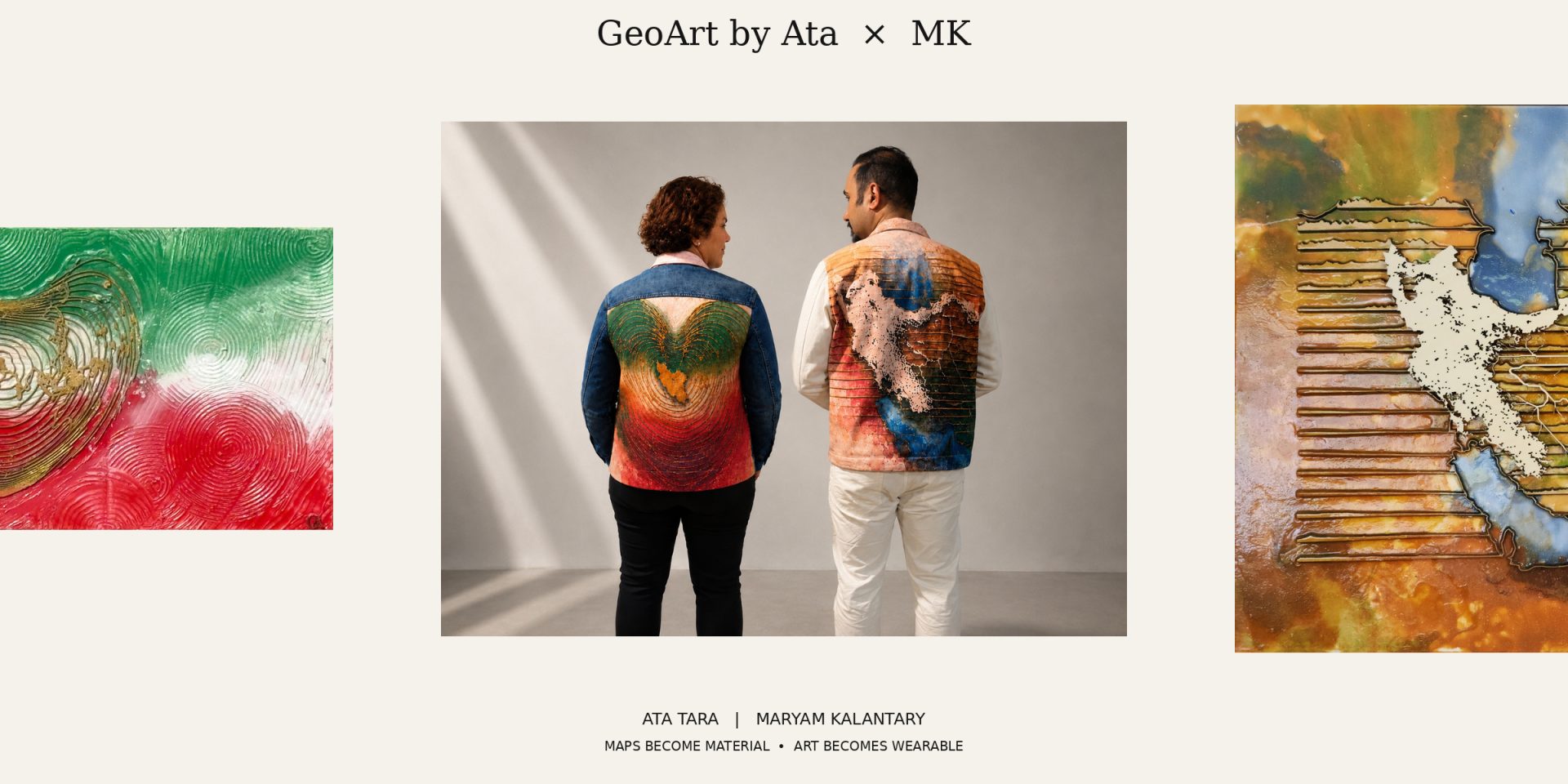
Now, through a collaboration with fashion designer Maryam Kalantary, this exploration is moving into another territory: the body itself.
We call this emerging body of work The Geography We Carry.
From geography to material
Maryam and I are partners in life as well as collaborators, but our creative practices come from different disciplines.
My background sits between landscape architecture, GIS, spatial planning, geodesign and art. Maryam brings the language of fashion: textile, construction, proportion, movement and the relationship between material and the human body.
There is also another geography connecting us.
We both come from Iran, and we have both made Australia home.
That experience of migration inevitably changes the meaning of geography.
When you migrate, geography is no longer simply where you are.
There is the geography you inhabit now, the geography you came from, and the landscapes, cultures and memories that continue to exist somewhere between the two.
Iran and Australia are separated by thousands of kilometres, but distance does not necessarily diminish the cultural and emotional presence of place.
You carry fragments of one landscape into another.
Language travels. Food travels. Colour travels. Stories travel. Memories of streets, mountains, gardens, architecture and family travel.
And perhaps maps travel too.
This personal experience has given the title The Geography We Carry a deeper meaning for us.
Culture is spatial
Iran has an extraordinarily rich visual and material culture.
Its architecture, gardens, textiles, carpets, calligraphy, geometry and decorative traditions demonstrate that relationships between culture and space have never belonged only to conventional cartography.
Pattern can describe a world.
A garden can represent an idea of landscape.
A textile can carry cultural memory.
Geometry can become architecture.
For me, GeoArt sits somewhere within this much larger conversation while using the contemporary languages of GIS, spatial data and mapping.
The work does not attempt to reproduce traditional Persian art. Rather, that cultural background inevitably sits within the way I understand landscape, geography, colour, pattern and belonging.
Living in Australia introduces another landscape and another spatial experience.
The result is not simply Iranian or Australian.
It exists between geographies.
And that condition—belonging to a place while continuing to carry another—is something many migrants understand.
From map to artwork to body
Our collaboration begins with GeoArt works that have already undergone several transformations.
Spatial information becomes mapping.
Mapping becomes abstraction.
Lines, boundaries and geographic structures become physical artworks through colour, texture, layering and material experimentation.
Maryam then introduces another transformation.
Artwork becomes textile.
The textile is cut.
It is assembled.
It encounters the dimensions of a human body.
And suddenly geography behaves differently.
A cartographic line that was static on an artwork bends around a shoulder. A boundary crosses a seam. A landscape disappears into a fold and emerges somewhere else as the person moves.
The body begins to participate in the map.
That is where this becomes more interesting to us than simply reproducing an artwork on clothing.
The garment creates another geography.
Wearing Iran, living in Australia
Some of our experiments make this relationship particularly explicit.
The colours, forms and cartographic traces of Iran can become part of a garment that is designed, made, photographed and worn in Australia.
For us, this is not intended as a nationalistic statement.
It is about cultural memory and belonging.
Migration rarely produces a clean break between one place and another. Instead, identities accumulate geographically.
We inhabit new landscapes while carrying traces of previous ones.
The map therefore becomes both literal and metaphorical.
When geography appears across the back of a jacket or moves across the surface of a garment, it raises a simple but powerful question:
How much of a place remains with us after we leave it?
Perhaps geography is something we carry long before we ever print it onto fabric.
Beyond the flat map
GIS and cartography have become extraordinarily powerful ways of seeing the world. Yet spatial information still overwhelmingly reaches us through screens, maps and flat visual representations.
I am increasingly interested in what happens when spatial information escapes those surfaces.
Could maps become sculpture?
Could spatial data become fabric?
Could geography be printed, laser-cut, layered, cast, woven or worn?
Could the material itself become part of spatial storytelling?
This is where I see GeoArt developing—not as a rejection of GIS or cartography, but as an extension of spatial thinking into artistic, cultural and material territory.
My earlier work in geodesign was concerned with using geographic knowledge to understand landscapes and imagine possible futures.
GeoArt follows another branch of that same enquiry.
It asks how geographic knowledge might become cultural experience.
And The Geography We Carry takes the question further:
Can geography become embodied experience?
Two practices, one geography
We are still experimenting, and that experimentation is important.
An artwork cannot simply be transferred onto fabric and expected to retain the same meaning.
Scale changes it.
Material changes it.
Cutting changes it.
The body changes it.
Movement changes it.
Maryam’s role therefore goes far beyond fabrication. Her fashion practice introduces another design intelligence into GeoArt: an understanding of material behaviour, garment construction, proportion and the moving body.
The collaboration becomes an exchange between two practices:
Geography provides the information.
GeoArt transforms it into visual and material language.
Fashion introduces the body.
The body carries geography back into the world.
And beneath all of this sits another movement:
Iran → migration → Australia → memory → mapping → material → body.
The geography we carry
Perhaps this project is ultimately less about clothing than it first appears.
It is about our relationship with place.
Where we come from.
Where we live.
What changes when we move between cultures.
And what refuses to disappear simply because we have crossed a geographic boundary.
For migrants especially, a map is never entirely abstract. Places can represent childhood, separation, family, identity, loss, discovery and belonging simultaneously.
Maryam and I now live and work in Australia, but Iran remains part of our cultural geography.
Australia, in turn, has become part of who we are and how we see the world.
The Geography We Carry sits somewhere within that space between the two.
It is still evolving, and perhaps that is appropriate. Geography itself is never completely static.
For now, we are continuing to ask what happens when a map leaves the screen, leaves the wall and encounters material, culture and the human body.
Maps become material.
Art becomes wearable.
Culture travels.
Geography becomes something we carry.
The Geography We Carry
A developing collaboration between Ata Tara / GeoArt and Maryam Kalantary / MK.
#GeoArt #TheGeographyWeCarry #Iran #Australia #Migration #CulturalIdentity #Cartography #GIS #SpatialStorytelling #WearableArt #FashionDesign #Materiality #Geodesign
